A Bornean tree makes hollow rooms for protective ants. Researchers found another tenant inside: a wasp storing paralysed flies.
From the outside, Macaranga pearsonii is a small tropical tree with broad leaves. Its most intricate landscape is hidden inside its stems.
There, hollow chambers provide shelter for colonies of Crematogaster ants. The tree also produces food bodies for them. In return, resident ants patrol the plant and can defend it from herbivores and encroaching vegetation. It is a mutualism built into wood: accommodation and food exchanged for protection.
Researchers working in Malaysian Borneo opened some of those chambers and found that the rooms were not occupied only by ants. A cavity-nesting wasp, identified as Dasyproctus agilis, had moved in.
A nursery in the stem
The wasp does not form a colony like the ants. A female uses a cavity as a nest, dividing it into cells for her offspring. She hunts flies, paralyses them and carries them into the stem as provisions for developing larvae.
Inside a tree already organised around one partnership, the wasp makes use of architecture it did not create.
The discovery is striking because Macaranga–ant relationships are among the best-studied examples of plant mutualism in Southeast Asia. Some species have evolved hollow stems, food and other features closely associated with their ant partners. The wasp introduces a third participant—not necessarily a destroyer, but an exploiter of available space.
What the study found
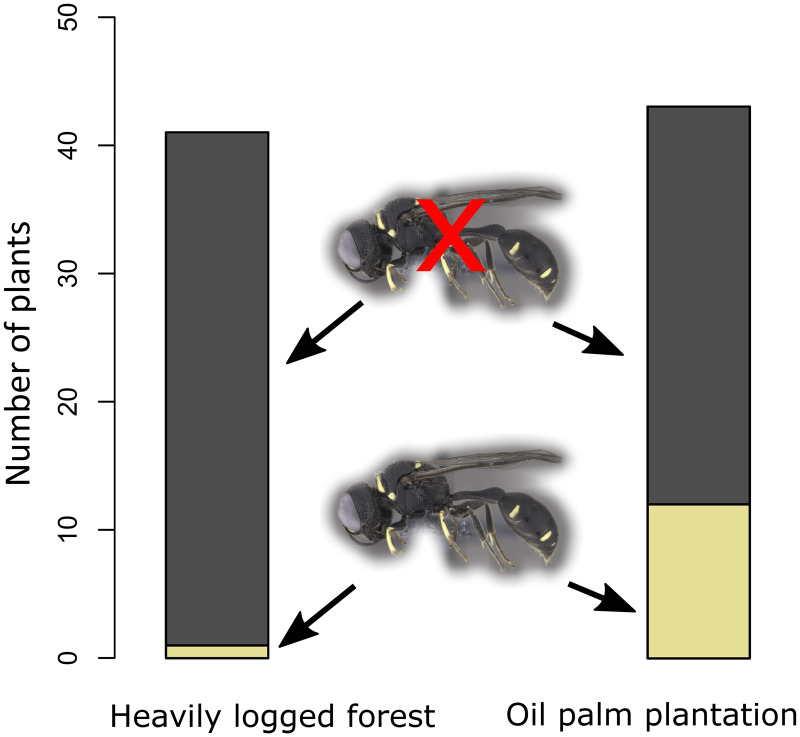
The researchers surveyed trees in logged forest and oil-palm landscapes in Sabah. Wasp occupation was more frequent in the oil-palm habitat, and occupied plants tended to have smaller ant colonies.
Those patterns are correlations. They do not prove that wasps caused ant colonies to shrink. Smaller colonies may leave more chambers available; habitat conditions may affect ants and wasps independently; several mechanisms may operate at once.
The researchers also looked for a consequence that might be expected if the ants’ protective service had weakened: greater leaf damage from herbivores. They did not find significant evidence that wasp occupation increased herbivory.
This is where a good biological story becomes more interesting by refusing a simple villain. The wasps used the ants’ housing and were associated with fewer ants, but the study did not show that they broke the partnership or harmed the tree.
Relationships under pressure
Mutualisms are often told as tidy exchanges between two species. In a forest, no relationship is sealed. Other organisms enter, steal, interrupt, assist or simply use what is available. A hollow stem can be an ant home from the tree’s perspective and a nursery from the wasp’s.
Land-use change may alter who gains access. The study found more wasp-occupied plants in oil-palm habitat than in logged forest, suggesting that disturbance could make established mutualisms more open to exploitation. But “suggesting” matters: the observations identify a pattern and possible vulnerability, not a complete causal chain.
The tree holds the whole problem at a small scale. Outside, a changed Bornean landscape. Inside, chambers, ants, wasp larvae and stored flies. What appears to be one organism is also habitat, food system and contested space.
It is tempting to ask which tenant belongs. The tree offers a stranger question. Once evolution builds a room, can it decide who moves in?
Trees I Saw is an observation project about trees, places and the stories that gather around them — treesisaw.com.
Sources
Figure: Lestina et al., PeerJ (2026), CC BY 4.0. Cropped/resized by the source image service.