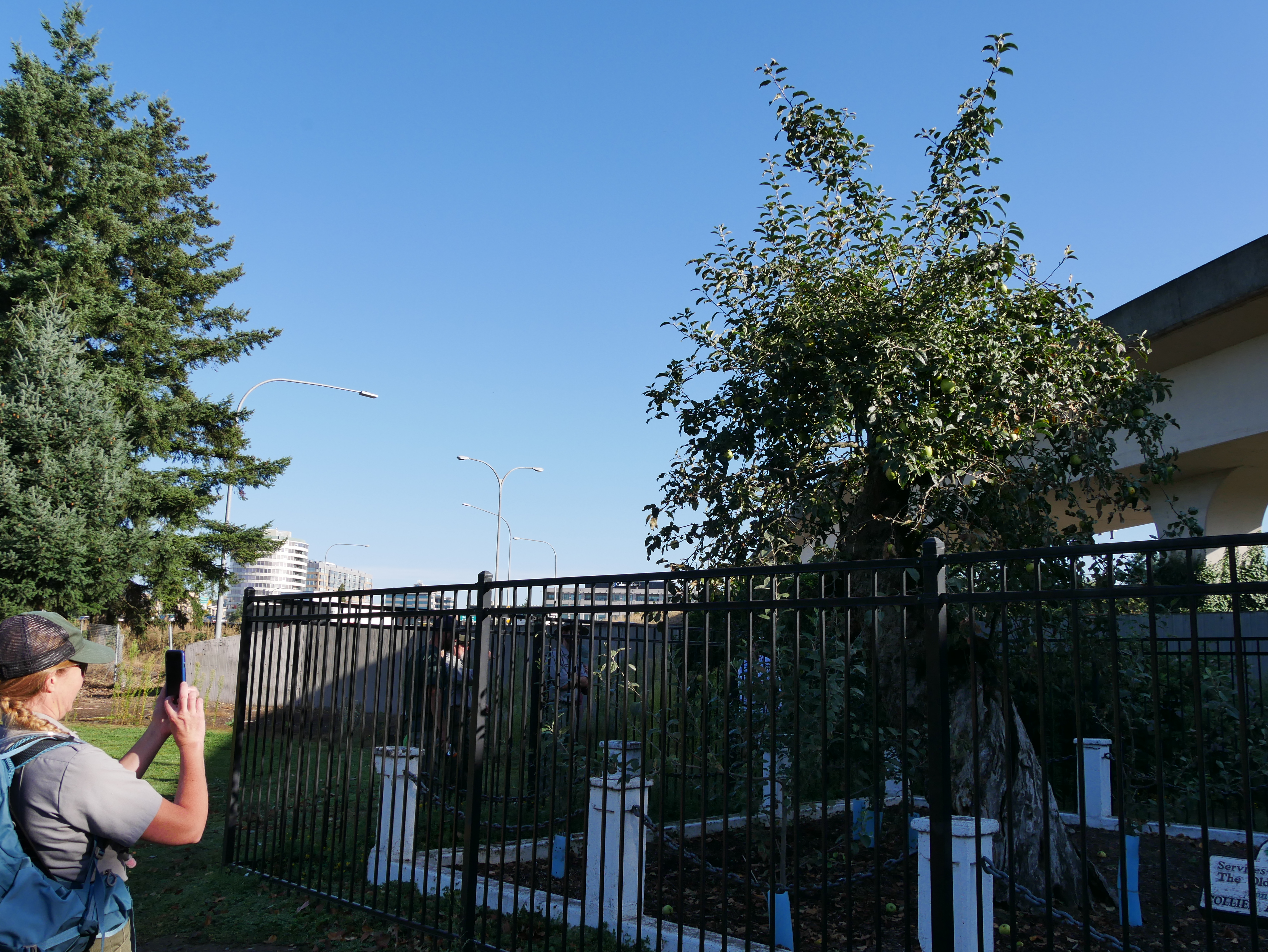
Vancouver’s Old Apple Tree lost its original trunk in 2020. Its roots—and the question of what makes a tree the same tree—remain alive.
Vancouver, Washington, planned a two-hundredth birthday party for a tree whose trunk had already died.
The contradiction is only apparent. In Old Apple Tree Park, the massive old stem is gone, but shoots from the surviving root system continue to grow. Elsewhere, propagated descendants carry the tree’s genes into a reconstructed orchard. The anniversary belongs at once to an organism, a lineage and a story.
A seed at the fort
Tradition dates the Old Apple Tree to around 1826 or 1827, during the early years of Fort Vancouver. A frequently repeated account says seeds arrived from an apple eaten at a London dinner and were carried west by Hudson’s Bay Company officer Æmilius Simpson. The precise journey belongs partly to legend; the tree’s exceptional age does not.
Unlike most cultivated apples, which are grafted onto separate rootstock to preserve a desired variety, this was a seedling growing on its own roots. That detail became important almost two centuries later.
The settlement around it changed beyond recognition. The Hudson’s Bay Company fort became a historic site; roads, railways and a modern city gathered nearby. The apple survived storms, pruning and the quiet biological limits of age. By the twentieth century it had become a civic landmark and the centre of an annual festival.
The trunk ends
A storm in 2009 damaged the ageing tree severely. On 25 June 2020, the remaining trunk finally failed. The National Park Service described the old tree plainly as dead.
That statement was true about the historic trunk and crown. It was not the whole biological story.
Because the tree grew on its own roots, shoots emerging directly from the root system are not seedlings and not grafts. They are vegetative growth from the same genetic individual. When a root sucker rises beside the place where the old trunk stood, the boundary between “the tree” and “a new tree” becomes difficult to draw.
Roots, cuttings and grafts
The Old Apple Tree also survives in other forms, but the distinctions matter.
Root suckers at the original site remain connected to the old root system. Suckers removed and replanted begin independent root systems, although they retain the same genetic material. Cuttings can also be rooted to make clones. Grafting takes a piece of the old tree and joins it to different rootstock: the upper growth is genetically continuous with the source, but the roots belong to another plant.
In 2004, descendants propagated from the Old Apple Tree were planted in the reconstructed Fort Vancouver orchard. After the trunk’s death, additional suckers and grafted trees were planted there in 2021. They are not the original two-hundred-year-old body. They are living continuations created by horticulture.
Which birthday is it?
The city’s Old Apple Tree Festival on 3 October 2026 marked two centuries since the traditional planting date. A birthday usually assumes a single body moving continuously through time. Trees make that assumption unstable.
If continuity means one unbroken trunk, the Old Apple Tree ended in 2020. If it means one connected root organism, something of the original remains at the park. If it means genetic lineage or cultural identity, the tree now occupies several places.
None of these definitions needs to defeat the others. The fallen trunk should not be declared alive. The root shoots should not be dismissed as mere replacements. And the propagated orchard should not be presented as two centuries old. Each carries a different kind of continuity.
Perhaps the festival celebrates not survival without interruption, but the care people took to make loss incomplete. The old silhouette has vanished. Near its former base, young stems are doing what apple trees do when damaged: beginning again from below the visible history.
When Vancouver says its oldest apple tree is turning two hundred, the most interesting word is not old. It is tree.
Trees I Saw is an observation project about trees, places and the stories that gather around them — treesisaw.com.
Sources
- City of Vancouver: Old Apple Tree Festival centennial announcement
- National Park Service: Requiem for the 1820s Fort Vancouver apple tree
- National Park Service: the Old Apple Tree lives on
Photo: National Park Service, public domain.