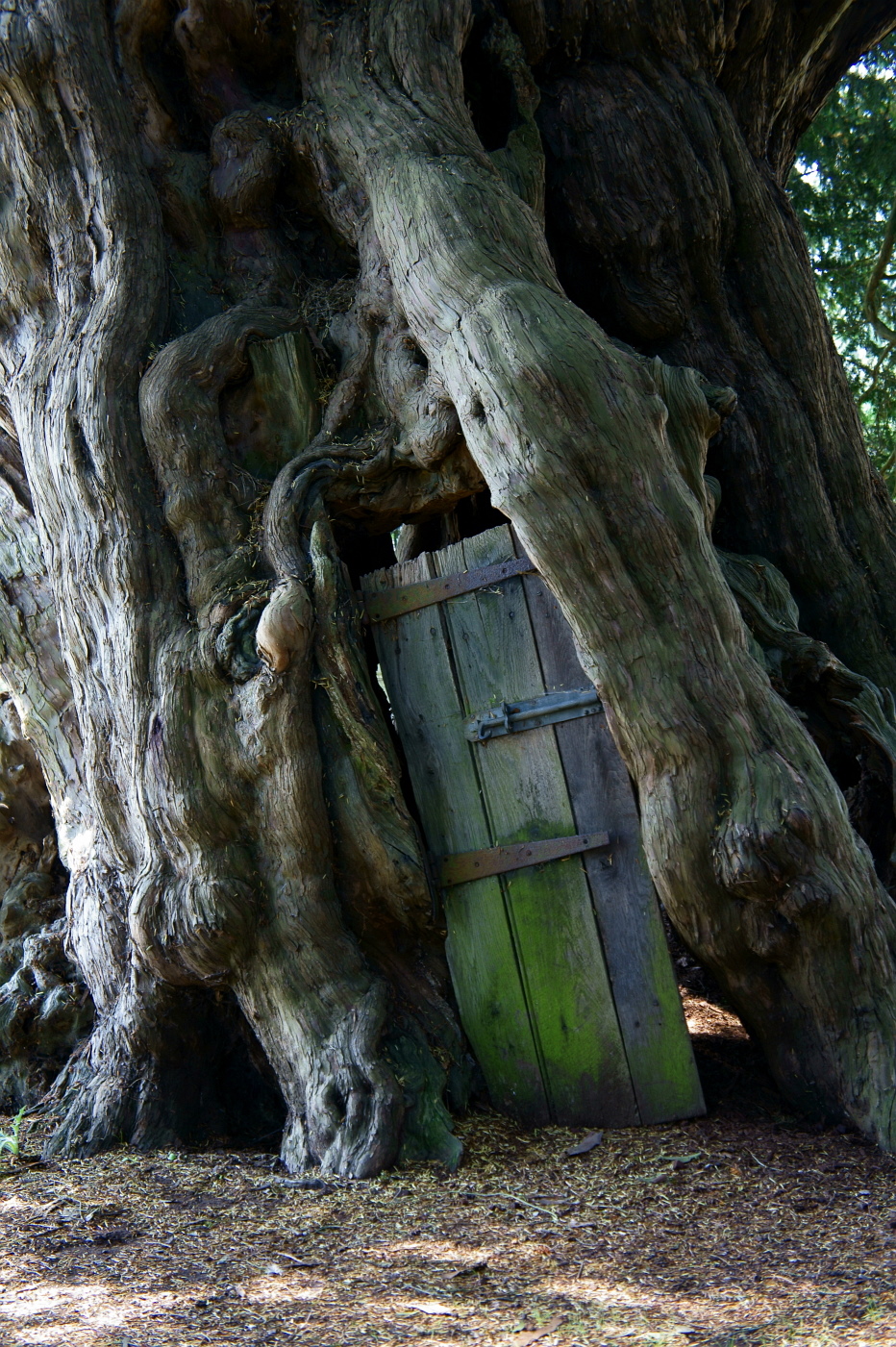
Villagers once turned the hollow trunk of an ancient English yew into a meeting room. The room disappeared, but its door—and the tree—remain.
There is a tree in Surrey, England, with a wooden door in its trunk.
Not a tiny decorative door, but the entrance to a space people once used as a meeting room. The tree is the Crowhurst Yew, standing beside St George’s Church. Its story asks a wonderfully strange question: when does a living tree become part of a village’s architecture?
An ancient tree beside a church
The Crowhurst Yew is an exceptionally old tree with an immense, hollow trunk. Its girth has been reported at roughly ten metres. Some accounts estimate it may be 4,000 years old, but precise ages for hollow ancient yews are difficult to establish: the oldest central wood may be missing.
Its great age is compelling, but the door is the detail that stops visitors in their tracks.
A room inside the trunk
The Woodland Trust records that villagers adapted the hollow trunk into a parish meeting space around 1820. Accounts describe a table, benches and a door. The room was an unusual attempt to make use of a living tree’s interior.
A hollow trunk does not necessarily mean a tree is dead. Yews can continue to grow with living tissues around an empty centre. But turning that centre into a room reveals how differently people have treated old trees over time.
A cannonball and a legend
Local history also tells of a cannonball discovered in the trunk during the nineteenth-century work. Tradition connects it with Cromwell’s soldiers and the English Civil War. The precise circumstances of the alleged impact are not independently proven, so the connection is best understood as a local story rather than a settled historical fact.
Even without the cannonball, the meeting room would make this tree extraordinary.
The room is gone. The tree remains.
A storm in 1845 reportedly destroyed the roof of the hollowed-out room. The yew survived. Its wooden door remains a clue to a chapter of village life that otherwise might be hard to imagine.
In 2026, the tree appeared on the Woodland Trust’s Tree of the Year shortlist, bringing renewed attention to this unlikely meeting place.
A different kind of monument
Most historic rooms survive because people maintain their walls and roofs. This one vanished while the tree that enclosed it continued living.
The Crowhurst Yew reminds us that trees are not merely backdrops to history. Sometimes they become the spaces in which history happens.
What would you think if you found a door in a tree?
Trees I Saw is an observation project about trees, places and the stories that gather around them — treesisaw.com.
Sources
- Woodland Trust: Tree of the Year 2026 shortlist
- Diocese of Southwark: St George’s Crowhurst ancient yew
- Ancient Yew Group: Crowhurst, Surrey
Photo: Peter Trimming, Wikimedia Commons, CC BY 2.0.