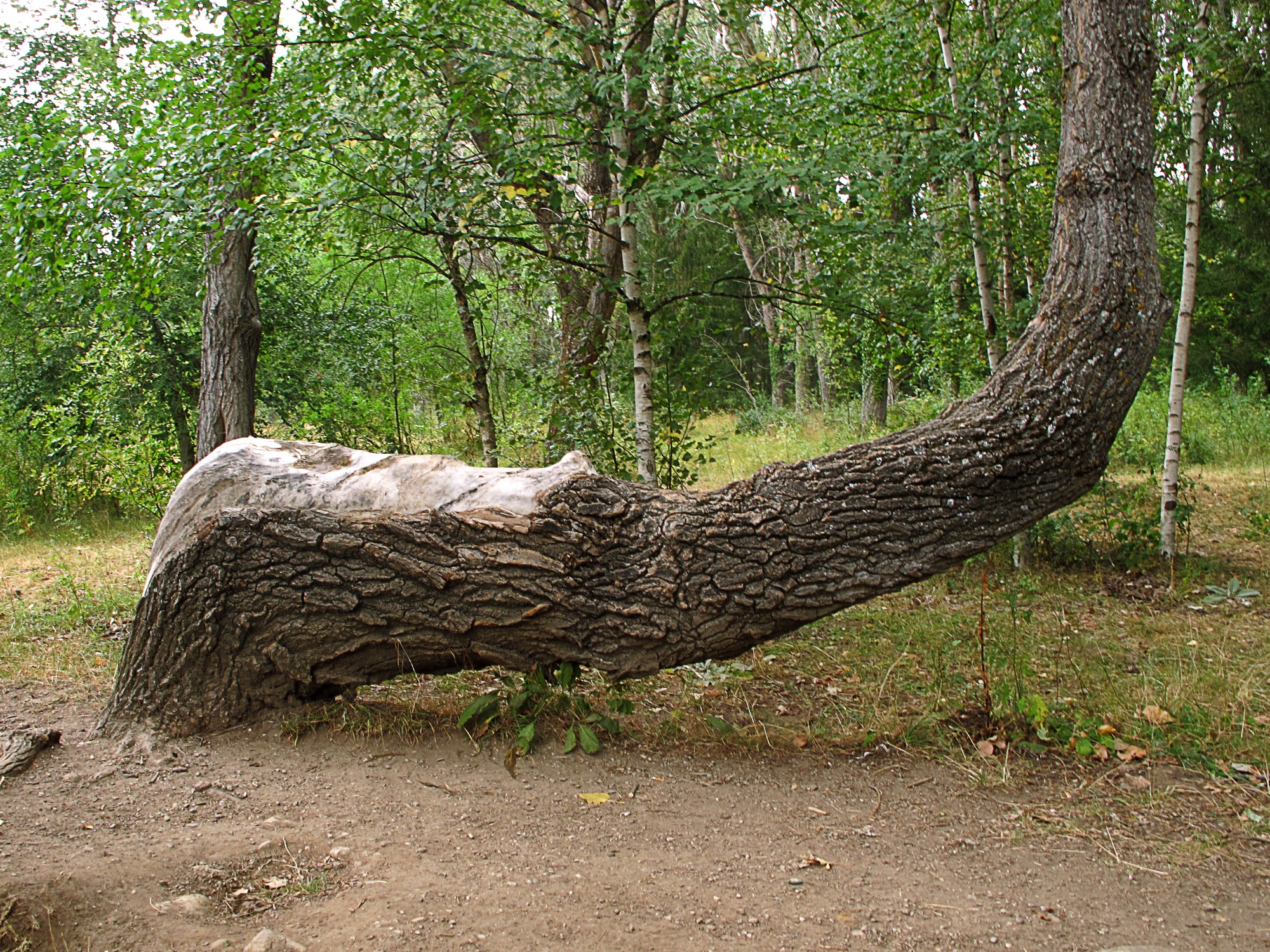
A tree begins close to the ground, travels sideways and then turns sharply towards the sky.
Another bends around a neighbour. A young trunk leans after a storm. On a hillside, a tree grows out almost horizontally before its crown rises vertically again.
We usually read these shapes as evidence. Something happened here: wind, snow, unstable soil, falling branches, competition for light, perhaps a human hand.
But that leaves out a second question.
What did the tree do about it?
Research published in New Phytologist on 2 September 2026 offers a remarkable answer. Trees can detect the curvature of their own stems and respond by building specialised wood in the direction needed to straighten them.
The headline version is that a tree knows when it is bent. “Knows” does not mean consciousness, thought or an experience like ours. It describes a biological feedback system: information about the tree’s own shape helps control what the tree grows next.
The lifelong problem of staying upright
A tree has to manage its posture for decades, sometimes centuries. All the while, it adds weight and height to a structure rooted in one place.
Wind moves the crown. Snow loads branches. Soil shifts. Neighbours fall. Light becomes available in one direction and disappears in another. A disturbance can change the angle of a stem in minutes, while correcting that change may take months or years of growth.
Plants already have well-known ways of responding to direction. Phototropism guides growth in relation to light. Gravitropism allows a shoot to sense its orientation relative to gravity. Both can help answer a question such as: which way should I grow?
But posture requires another kind of information too.
Knowing which way is up is not the same as knowing what shape you have become.
Does a tree sense its own shape?
Researchers use the word proprioception for this second process.
In humans and other animals, proprioception lets us perceive the position and movement of our body parts without watching them. Close your eyes and raise one hand: you still know, roughly, where it is.
Plants do not have nerves, muscles or a human-like inner experience. In plant science, proprioception describes feedback about curvature and posture within the growing organism itself.
The idea was not new. Earlier mathematical and experimental work had suggested that a plant could not reliably stabilise its posture using gravity alone. Without feedback about its own curve, an upward-growing shoot might overshoot, correct back the other way and continue oscillating instead of becoming straight.
What had been missing was direct experimental evidence showing how a woody stem turns that information into mechanical action.
Alexandre Caulus and colleagues set out to find it.
First, bend the tree
The researchers worked with young hybrid poplars, Populus tremula × alba.
They first placed the trees horizontally. The stems responded by curving upwards, bringing their tips back towards a vertical position. This is a gravitropic response, but the movement was not produced by anything resembling a joint.
The trees made wood.
Broadleaved trees can form a specialised type of reaction wood called tension wood. As it develops, it generates tensile forces—a pull—on one side of a stem. During the poplars’ upward bending, tension wood formed on the upper side and helped draw the stems into a curve.
After about ten days, the stems were upright at their tips but no longer straight. They had acquired a pronounced bend.
At that point, the researchers changed the world around them.
Then remove “up”
To isolate the influence of the stem’s curvature, the team had to stop the trees receiving useful directional information from gravity and light.
They transferred the bent poplars to a specially designed clinostat: a horizontal platform rotating around its own axis. Rotation continually changed the plants’ orientation relative to gravity, preventing a stable gravitational direction from guiding the response. The apparatus sat inside a sphere flooded with light from all directions, removing a directional light cue as well.
Where is gravity?
Where is the light?
Those signals had been neutralised.
One crucial piece of information remained:
What shape am I now?
And the trees kept correcting themselves
Over the following weeks, the curved stems gradually became straight.
That change might have been explained as passive springback—the release of stored elastic force after bending. But the anatomy of the new wood revealed an active response.
When the rotating device was switched on, the tension wood that had formed on the original upper side stopped developing. Then anatomically equivalent tension wood appeared on the opposite, convex side of the curved stem. Its pulling force acted in the opposite direction, progressively counter-curving the stem until straightness was restored.
INRAE compares the two phases to antagonistic muscles: one produces movement in one direction, the other opposes it. Trees do not literally have muscles, but the analogy captures the coordinated mechanical effect.
The scientific paper goes further. Measurements showed that the corrective response followed a control rule linked to the degree of curvature. The curve was not simply an outcome of earlier growth. Its magnitude was information used to govern the next phase of growth.
Trees solve problems at the speed of wood.
A revised picture of tension wood
The traditional account of tension wood emphasised gravity: when a broadleaved stem leans, it forms tension wood on the upper side and pulls itself upwards.
The new study does not replace gravitropism. It shows that the formation of reaction wood is governed by a balance between information about orientation and information about curvature. Gravity helps a stem find a direction; proprioception helps prevent the resulting movement from becoming an uncontrolled curve.
Together, these feedbacks allow a tree to bend and then to straighten.
That coordination matters beyond a laboratory. INRAE points to storms and landslides as disturbances that can alter the posture of trees. The study helps explain part of the biological machinery through which a surviving tree can regain a workable form afterward.
It does not mean every bent tree will become straight. Damage, age, species, available resources and the continuing forces around it all matter. A curve may persist even as new growth adjusts its direction.
Look at a crooked tree again
Return to the tree beside the path.
Its bend may record a fall, a slope, another tree that once blocked the light, or an event we can no longer reconstruct. The particular tree in the photograph above, from the Bosque de Finlandia in Rascafría, Spain, was not part of the poplar experiment, and the cause of its dramatic shape is uncertain.
But look at where its trunk goes next.
A leaning stem, a sudden turn, a branch that becomes a replacement leader: each can contain more than one history. There is the disturbance that changed the tree. Then there is the growth that followed.
A curve can show both what happened to a tree and what the tree did in response.
Trees keep records differently
We often describe trees as archives because their rings preserve internal traces of drought, fire, injury and seasons of growth. Their external architecture is another kind of record.
It is less orderly than a sequence of rings. Branches break. Trunks twist. Crowns rearrange themselves around gaps. New wood applies force to old form. The visible tree is the result of a continuous negotiation between inherited structure, surrounding conditions and active growth.
This is why an irregular tree can be more revealing than a symmetrical one. Its shape does not merely show where growth occurred. It may show growth making a correction.
What a tree does after the storm
A tree can sense that it is bent.
But perhaps the more interesting sentence is what comes next.
It can do something about it.
So the next time you pass a tree whose trunk makes an unexpected curve, do not only ask what bent it.
Look at where the curve goes next.
The tree may have already written the answer.
Trees I Saw
Every tree has a shape. Sometimes the shape is the story.
Sources and image
- Caulus et al. (2026), “Proprioception drives tension wood formation for autotropic straightening and postural control in trees”, New Phytologist
- INRAE: A newly discovered role for tension wood—the “muscle” trees use to correct their posture
Image: a curved tree in the Bosque de Finlandia, Rascafría, photographed by Jacinta Lluch Valero on 30 August 2014. This tree was not part of the experiment and the cause of its shape is uncertain. Wikimedia Commons, CC BY-SA 2.0. The image has been resized; no other changes were made.
.jpg)